Elizondo, the town with Amaia’s police station
Ofrenda a la tormentaElizondo, the town with Amaia’s police station, is more than a backdrop to the investigation: its streets and station hold urgent encounters, while its place on the map helps turn scattered infant deaths into a river-shaped pattern. The town is at once a site of police work and a point from which the wider geography of the cases becomes legible.
Setting and First Police Encounters
In driving rain, Amaia Salazar arrives at the town’s Lamias fountain and passes beneath a small arch into Pedro Axular Street. A distressed crowd presses toward a patrol car, where a tired-looking man rests his head against the rain-streaked glass; nearby, officers struggle to secure a backpack lying in a puddle. Inspector Iriarte is trying to contain the crowd, and Amaia calls for reinforcements as two more siren-blaring cars cross Giltxaurdi Bridge. The weather, the crowd, the vehicle, and the abandoned bag make the street a scene of public alarm before the investigation has even settled into the station.
The station’s design offers a contrasting image of controlled observation. Its new cells have no bars: thick walls of armored glass separate detainees from the identification area, where a spotlight illuminates each cubicle and a camera records continuously. Amaia walks past the open cells to the one occupied by Valentín Esparza, who sits on the floor between the sink and toilet with his knees drawn up and his arms crossed over them. Iriarte calls his name through the intercom, and the man raises his head. The transparent barrier makes custody visible, but does not remove the distance between the officers and the person they are questioning.
Homes, Work, and the Investigative Map
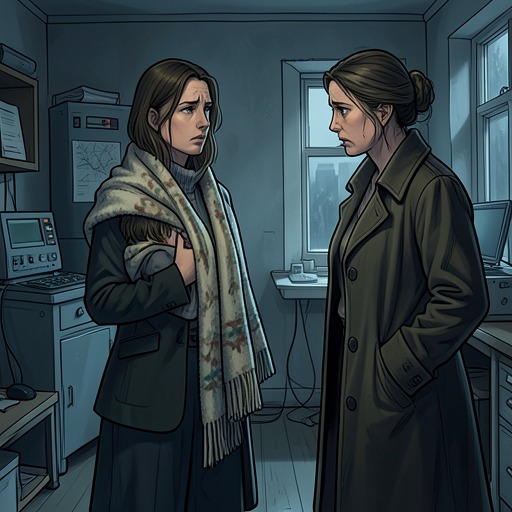
Elizondo also anchors Amaia’s movements away from official police work. After passing Juanitaenea, where building materials sit stacked outside without any sign of activity, she considers stopping at Ros’s bakery but decides against it. Instead, she parks by the old market and returns on foot to find Elena Ochoa. Ochoa pulls her inside, checks the street, and leads her to the kitchen, where she begins preparing coffee. The domestic ritual gives Amaia time to order the fragments that have brought her there, making a private home another place where the inquiry takes shape.
Later, Elizondo becomes a marked point in Amaia’s review of the case geography. Jonan Etxaide’s scenario file lists addresses of babies whose deaths had already been investigated and adds Amaia’s sister, whose grave had been found empty. Amaia redraws the map, placing her sister in Elizondo while leaving Ainhoa unmarked. When she studies the victims’ origins against the course of the Baztán River, the points form a line from Erratzu through Arraioz, Elbete, and Elizondo, continuing toward Oieregi with Haizea’s case. Elizondo’s significance here is not that it explains the deaths by itself, but that it occupies a revealing position in the pattern Amaia is beginning to see.
Elizondo in the River-Corridor Pattern
At a briefing, Amaia places red marks on a map of towns along the river and toward the boundary with Guipúzcoa. The known cases raise a difficult limit: the team cannot confirm its suspicions about the child in Ainhoa or obtain judicial permission to examine the grave again. Even so, the distribution around the river gives the investigators a defined area in which to compare families and circumstances. Elizondo is one of the communities within that geography, and the town’s local cases connect the police inquiry to a wider sequence rather than an isolated crime scene.
The investigation expands as baptism records are checked parish by parish, a slow process because the relevant information is held by parish priests and can only be consulted during office hours. After narrowing the cases, the investigators identify one in Elizondo, alongside cases in Oronoz-Mugaire and Narbarte, two in Doneztebe, and two in Hondarribia. Amaia then asks that older cases also be added in another color, including the girl from Argi Beltz and her own sister, as well as children from Lesaka, Elbete, and Erratzu. The resulting chain follows the watercourse from its source to its mouth, with Elizondo among the towns that give the pattern its human scale.
Narrative Significance
Elizondo’s different spaces—street, station, home, and map—show the investigation moving between immediate crisis and patient comparison. In the street, the rain and crowd make police work public and unstable; behind the station’s glass, detention is subjected to continuous scrutiny; in Ochoa’s kitchen, the search for answers proceeds through a quiet, repetitive domestic routine. On the map, Elizondo becomes one point in a sequence that crosses towns and administrative boundaries. Its importance lies in this double role: it is where investigators encounter people and evidence directly, and where the river corridor makes separate losses appear connected.